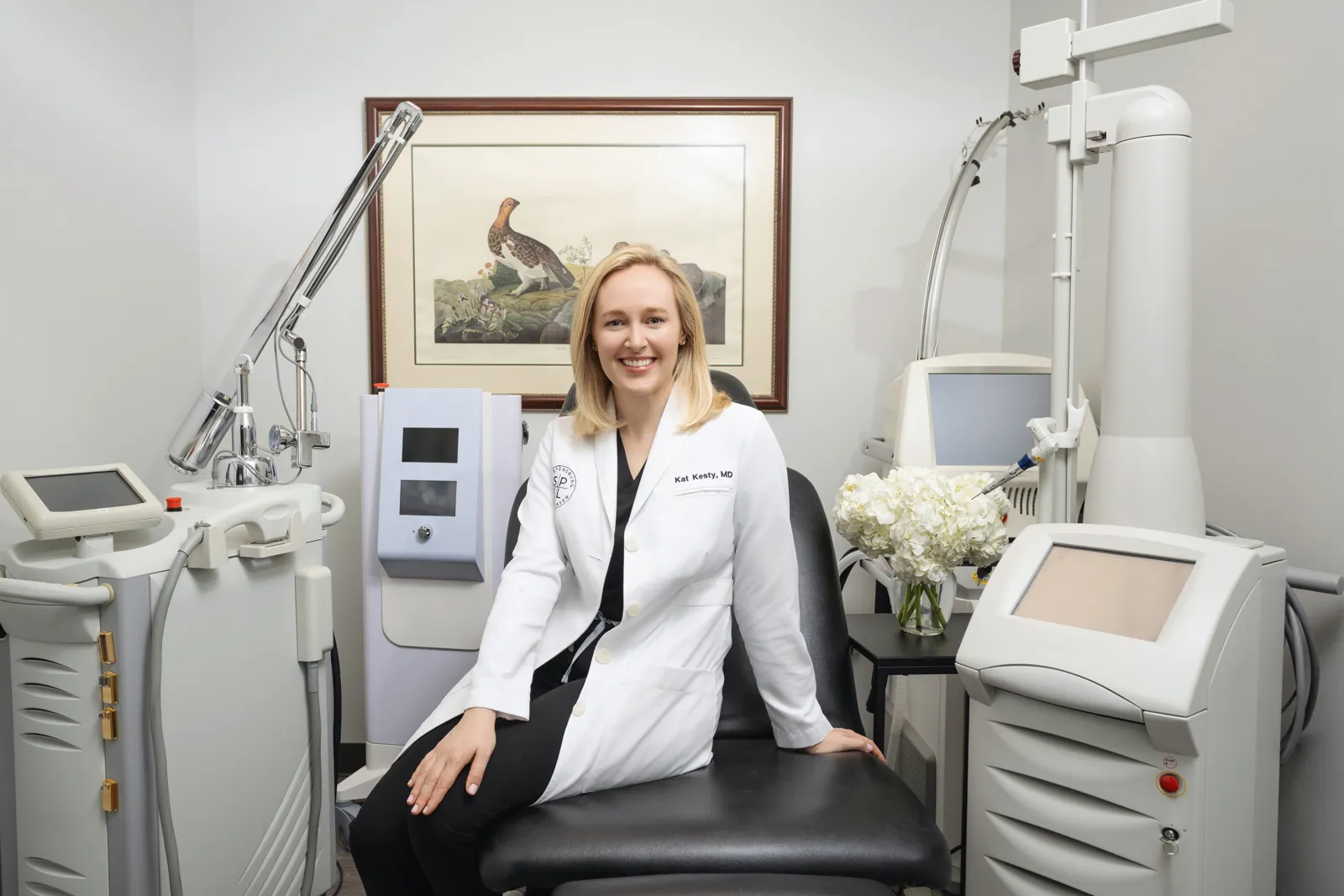
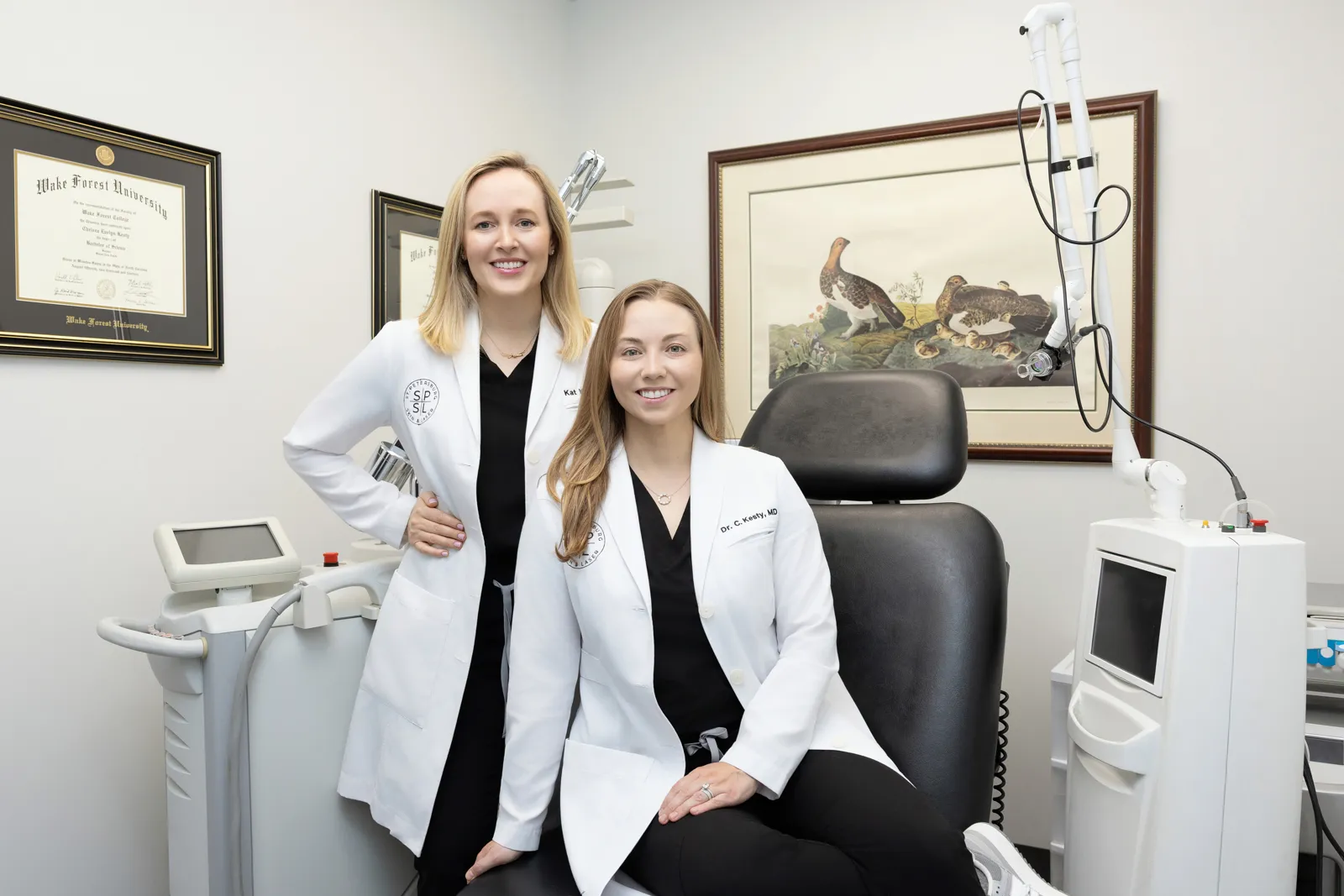
Medically reviewed by Dr. Kat Kesty, MD, double board-certified dermatologist and fellowship-trained Laser surgeon. Last updated .
Laser tattoo removal at a glance
- Treatment time
- Minutes for a small tattoo, longer for large or multicolored work
- Sessions
- About 8 on average; fewer for a cover-up, more for dense or resistant ink
- Spacing
- 8 to 12 weeks between sessions
- Wavelengths
- 1064 nm, 532 nm, 595 nm, 660 nm
- Comfort
- Topical numbing, injectable local anesthetic, Pro-Nox nitrous oxide
- Performed by
- Dr. Kat Kesty or Dr. Chelsea Kesty, double board-certified dermatologists
Here is the number most people want first: about eight sessions, spread eight to twelve weeks apart, which works out to roughly a year and a half for a typical tattoo. Some finish in five. Dense, layered, or previously treated tattoos can take considerably more. The visit itself, for a small tattoo, takes minutes.
That gap between "minutes in the chair" and "a year and a half" is the whole story of tattoo removal, and it is why we spend the rest of this page on what happens in between.
How Picosecond tattoo removal works
Tattoo ink sits in the dermis, below the layer of skin that turns over. Your body has been trying to clear it since the day you got it and cannot, because the particles are too large for immune cells to carry away.
A Picosecond Laser delivers energy in pulses as short as 250 Picoseconds. That is short enough that the ink particle absorbs the energy before it can conduct heat outward. The particle expands faster than it can handle and fractures. This is a photomechanical effect, sometimes called photoacoustic; older Q-switched Lasers relied much more on heat. Smaller fragments are small enough for the body to clear, and it does, gradually, over the weeks after each session.
The Laser does the breaking. Your body does the removing. That second job is slow and is the reason sessions are spaced the way they are.
Four wavelengths, and why that matters for color
Different ink colors absorb different wavelengths of light. Treat a yellow tattoo with a wavelength yellow does not absorb and nothing happens. A single-wavelength device treats black well and struggles with everything else, which is how many of the "stubborn" tattoos we see got that way.
Our Picosecond platform offers four:
| Wavelength | Ink colors it targets | Notes |
|---|---|---|
| 1064 nm | Black, dark gray, brown, dark blue, some green and purple | Safest option across all skin tones, including Fitzpatrick V and VI |
| 532 nm | Red, orange, yellow, some pinks and warm tones | Absorbed by melanin too, so skin type dictates the settings |
| 595 nm (dye handpiece) | Selected yellow, orange and related pigments | For colors that resisted conventional wavelengths |
| 660 nm (dye handpiece) | Blue, green, teal, cyan, turquoise | Historically the hardest colors; this is the tool for them |
A multicolored tattoo may need two or three of these across its treatment series. Your physician looks at the tattoo under magnification, sorts the colors, and picks the wavelength for each. More wavelengths mean more options. They do not mean a guarantee.
Green and blue tattoos
These are the ones people bring us after giving up somewhere else. Blue and green pigments absorb poorly at 1064 nm and not at all at 532 nm, so a two-wavelength device tends to fade the black outline and leave a green ghost behind.
The 660 nm dye handpiece exists for exactly that ghost. Some green formulations remain slower than black even with the right wavelength, and we tell patients up front that green may need extra sessions. We can rarely say in advance which particular green will be the slow one. That is an honest limit of the technology.
Yellow, white and light inks
Yellow is unpredictable. The 595 nm handpiece gives us a wavelength that yellow absorbs, which most practices in the area do not have, but it still takes patience.
White is a different problem, and a small tangent is worth it. Many white and cream inks are made with titanium dioxide, the same pigment in sunscreen and house paint. When titanium dioxide is hit with a Laser it can reduce to a darker compound and the tattoo turns gray or black instead of fading. The FDA's fact sheet on tattoo inks describes the ingredients involved. We test a small area first on any tattoo with white in it, and we tell you plainly that complete removal of white may not be possible.
Why some colors take longer
It is not a matter of turning up the power. The Laser has to hit the ink with a wavelength the ink absorbs, and then the body has to clear what is left. Along the way, all of this changes the count:
- Ink chemistry and how densely it was packed
- Depth, which depends on the artist and the machine
- Age of the tattoo
- Professional versus amateur application
- Number of layers, including cover-ups
- Previous Laser treatment
- Your skin type and how fast your immune system clears particles
As a rough guide: black and dark inks respond fastest, red and orange respond well with the right wavelength, blue and green can be slow, and yellow, white and pastels are the least predictable.
How many sessions will I need?
There is no universal number. Eight is a fair average. Small, single-color, amateur black tattoos sometimes finish in four or five. Dense professional sleeves with color, cover-ups over cover-ups, and tattoos already hit with an older Laser can run well past ten.
Your physician gives you a range at the consultation, after looking at the ink, your skin, and any previous treatment records you can bring. Bring them. Knowing which wavelengths already failed changes the plan.
Why treatments are 8 to 12 weeks apart
Because the removal keeps happening after you leave. The Laser fractures ink in seconds; your immune system spends the next two months carrying the fragments away. Treating again before that finishes just re-hits ink that was already on its way out, and it raises the risk of skin irritation for no gain. The wait is part of the treatment.
For patients traveling from out of town, that spacing is convenient. Two or three sessions can be lined up with trips to St. Petersburg over a year. Our out-of-town patients page covers logistics.
Does Laser tattoo removal hurt?
Yes, some. Most people compare it to the tattoo going on, or to a hot rubber band snap repeated quickly. A small tattoo is over before it becomes a problem. Larger ones we manage.
You have three options here, and you can combine them:
- Topical numbing cream applied before treatment.
- Injectable local anesthetic for sensitive spots like ribs, ankles, or fingers, or for larger areas.
- Nitrous oxide through our Pro-Nox system, the same "laughing gas" used in dental offices, for patients who want to be relaxed. We wrote a separate guide to Pro-Nox at our practice.
Nobody has to tough it out.
What happens right after, and will it scar?
The treated skin turns white immediately. This is called frosting and it is gas released from the fractured ink. It fades within about half an hour. Then the area is red, swollen, and tender, similar to a fresh sunburn, for a day or two.
Over the next week some patients blister. Blisters can be large and can look alarming. They are part of the expected healing response and they heal cleanly if you leave them alone. Crusting and scabbing follow, then the skin settles. Do not pick, pop, or scrub any of it.
Scarring
Most patients do not scar. Picosecond Lasers cause less collateral heat than older technology, and the surface of the skin is not intentionally removed. That said, no Laser tattoo removal can promise zero risk of scarring, and we will not.
The things that raise the risk are mostly in your control: picking blisters or crusts, sun on the area during healing, infection, and skipping the aftercare instructions. Things we control: energy settings, wavelength choice for your skin type, and honest assessment of dense or previously scarred tattoos before we start. A history of keloids gets discussed before any treatment. If you already have scarring from an old tattoo or a previous removal attempt, our scar treatment page covers what can be done about it.
Side effects
Expected and temporary: redness, swelling, warmth, tenderness, frosting, blistering, crusting, scabbing, and short-term darkening or lightening of the treated skin.
Less common: infection, pigment changes that persist, scarring, changes in skin texture, and ink that changes color under the Laser. Your physician goes through all of this at the consultation and in writing.
Tattoo removal on darker skin
Many skin types can be treated. The safe wavelength depends on both your skin and the ink.
Darker skin contains more melanin, and melanin competes with tattoo ink for Laser energy at shorter wavelengths. The 1064 nm wavelength is the workhorse for dark inks across Fitzpatrick I through VI because melanin absorbs relatively little of it. The 532 nm wavelength, used for red and orange, needs lower energy and more caution in darker skin, and sometimes gets deferred in favor of a slower, safer approach.
This is where having a dermatologist matters. Both of ours have treated a lot of Fitzpatrick IV to VI skin with Lasers, and they know when to say not yet.
If your tattoo has failed other Lasers
This is one of the most common reasons patients find us. A tattoo that stopped responding is usually one of two things: leftover colors that the previous device could not reach, or ink that was fragmented but not fully cleared. Occasionally it is a titanium-dioxide reaction that darkened the ink.
The combination of 250-Picosecond pulses and four wavelengths, including the 595 and 660 nm handpieces, gives us tools the previous provider may not have had. It is not magic. Some residual ink is simply hard to fragment. We will tell you which case you are in after we look.
Can it be completely removed?
Not always, and anyone who guarantees it is guessing. Many tattoos fade to the point where nobody would notice them. Others leave a faint shadow, a little residual color, a slight difference in skin tone, or a subtle texture change. Green, blue, yellow, white, pastel, dense, and layered ink are the ones most likely to leave something behind.
Our aim is the most fading possible with the skin around it kept healthy. We would rather stop one session early than push settings past what your skin tolerates.
Lightening a tattoo for a cover-up
You do not have to remove it. A lot of patients want the old tattoo faded enough that a new artist can work over it without the old design showing through. That usually takes fewer sessions than full removal, sometimes half. Tell us what the cover-up plan is; it changes how much fading is enough.
Eyebrow and permanent makeup removal
Microbladed brows, permanent eyeliner, and lip liner are tattoos, and they can be treated. They also carry a specific risk: many cosmetic pigments contain iron oxide or titanium dioxide, both of which can darken under a Laser. We test a small area first, every time, and we discuss the odds honestly before touching a brow. Not every cosmetic tattoo is a good candidate.
What does Laser tattoo removal cost?
Pricing is per session and depends on the size of the tattoo. Colors and density change how many sessions you need, not the per-session price.
| Tattoo size | Per session |
|---|---|
| Up to 2 × 2 inches | $700 |
| Up to 4 × 4 inches | $900 |
| Up to 8 × 8 inches | $1,200 |
| Larger than 8 × 8 inches | Quoted at consultation |
Your $197 consultation fee is applied to treatment.
If you are comparing prices, ask two questions of every provider: how many wavelengths does the device have, and who is holding it. A cheap session on a single-wavelength device operated by a technician can cost more over a year and a half than a well-matched session performed by a physician, because it takes more of them. Our blog on who can perform Laser treatments in Florida explains why that matters.
Aftercare, day by day
- 1
Day of treatment
Cool compress for swelling. Keep it clean and covered with a non-stick dressing and a bland ointment.
- 2
Days 1 to 3
Redness and swelling peak. Blisters may form. Leave them intact.
- 3
Days 4 to 10
Crusting and scabbing. No picking, no scrubbing, no soaking in the Gulf or a pool.
- 4
Weeks 2 to 4
Skin settles. Sunscreen on the area every day, or keep it covered. Sun on healing skin is the fastest route to a pigment problem.
- 5
Weeks 4 to 12
The ink keeps fading. This is the part that looks like nothing is happening. It is.
You get these in writing, adjusted for the area we treated.
Why choose St. Petersburg Skin & Laser
Tattoo removal is not one-size-fits-all. The result depends on ink color, wavelength, skin type, ink depth, ink density, and what has already been tried. We bring 250-Picosecond pulses, four wavelengths, three comfort options, and two dermatologists who do every treatment themselves. Dr. Kat Kesty is a fellowship-trained Laser surgeon; Dr. Chelsea Kesty is a double board-certified dermatologist. That level of training is rare in tattoo removal, where most treatments in Florida are performed by technicians.
The same Picosecond platform is what we use for Laser facials for melasma and sun damage, so if the skin around a tattoo has pigment issues, both can be addressed here. Read about what to expect at a Laser appointment before your first visit.
Frequently asked questions
References
- U.S. Food & Drug Administration. Tattoos & Permanent Makeup: Fact Sheet. fda.gov
- American Academy of Dermatology. Tattoo removal: Lasers outshine other methods. aad.org
100 40th Ave N, St. Petersburg, FL 33703 · 727-474-9399
Monday to Friday, 8:30 AM to 5:00 PM. Patients come from Tampa, Clearwater, Bradenton and across Pinellas County.
Related treatments
Pages patients read alongside this one.
- Laser facial (pico)Same Picosecond platform for melasma, sun spots and brightening. No downtime.Read more
- Scar treatmentFor scarring from an old tattoo or a previous removal attempt.Read more
- Nitrous oxide at our practiceHow we use laughing gas to make longer sessions comfortable.Read more
- Who can perform Lasers in FloridaWhat the law allows, and why a dermatologist is different.Read more
- Out-of-town patientsLining up sessions with travel to St. Petersburg.Read more
- Laser skin resurfacingEvery Laser option we offer, in one place.Read more

Trusted by Patients & Recognized by Industry Leaders